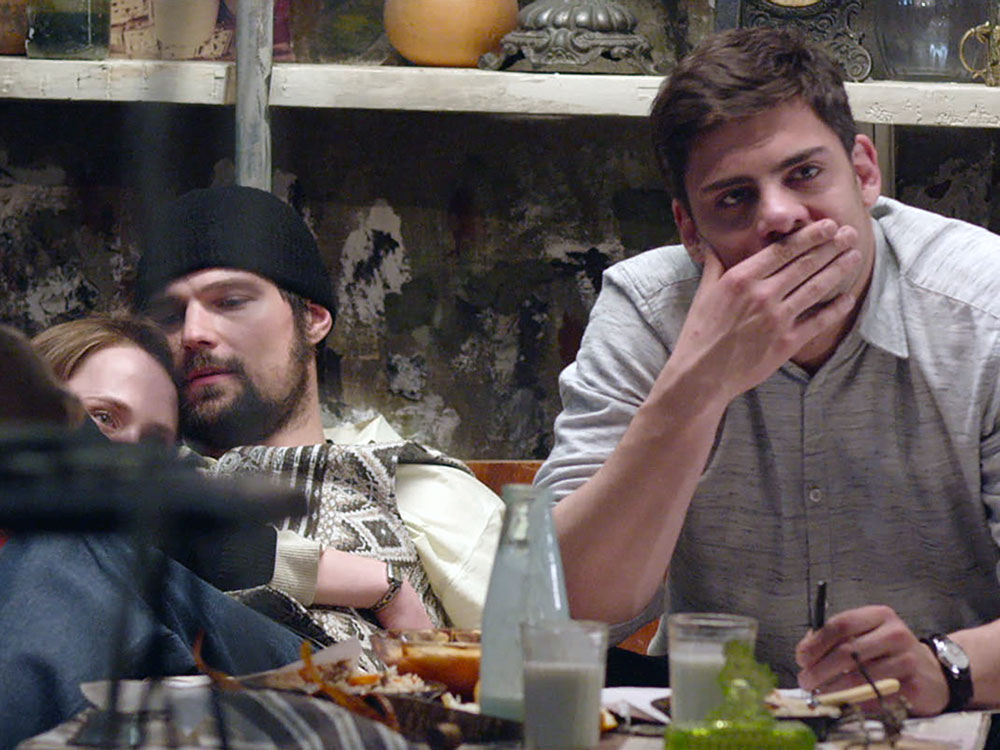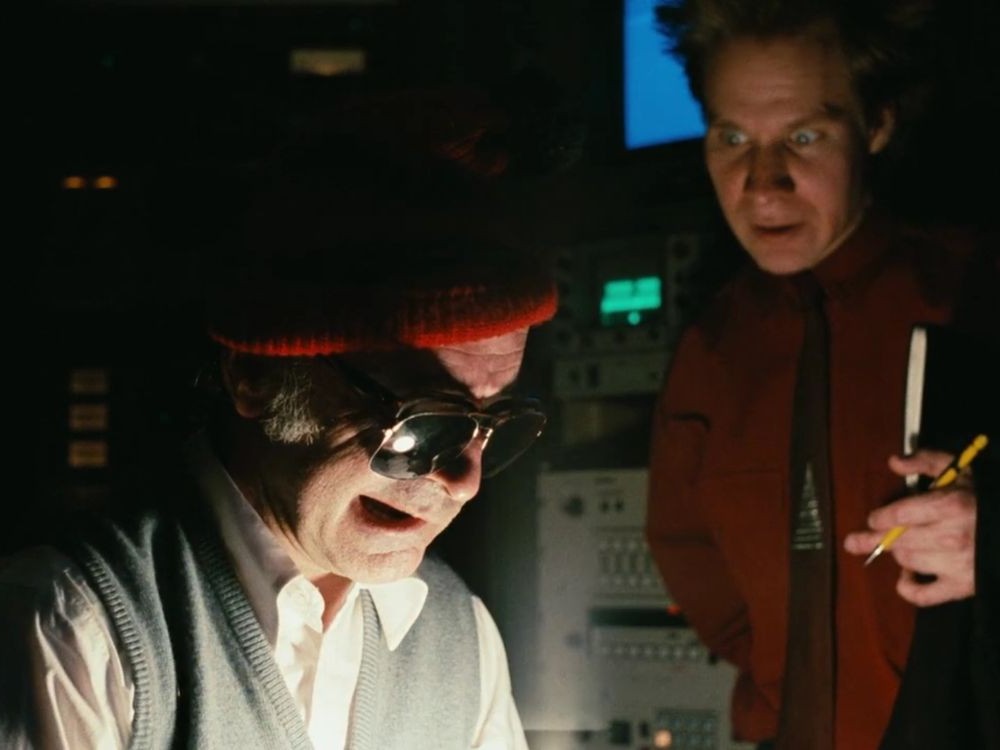
King Lear, dir. Jean-Luc Godard, USA, 1987, 90 min
Jean-Luc Godard first expressed a desire to adapt King Lear in 1982. Three years later, he signed a $1 million deal for the project on a napkin at Cannes with Menahem Golan of Cannon Films. This marked the beginning of a tortuous, acrimonious production.
The final film retains traces of the various abandoned versions on whose ruins it is built. Godard’s initial idea was to film an interview with Orson Welles or Joseph Losey, who would play Lear as the owner of a Los Angeles parking lot or second-hand car garage. He also envisaged exploring how other filmmakers had approached Lear previously and contacted Losey, Welles, Laurence Olivier and Ingmar Bergman in the hopes of finding a guide to help him navigate what he termed the ‘foreign country’ of Shakespeare. Bergman and Welles accepted, but Welles sadly died shortly afterwards and Bergman ‘faded away’, as he put it.
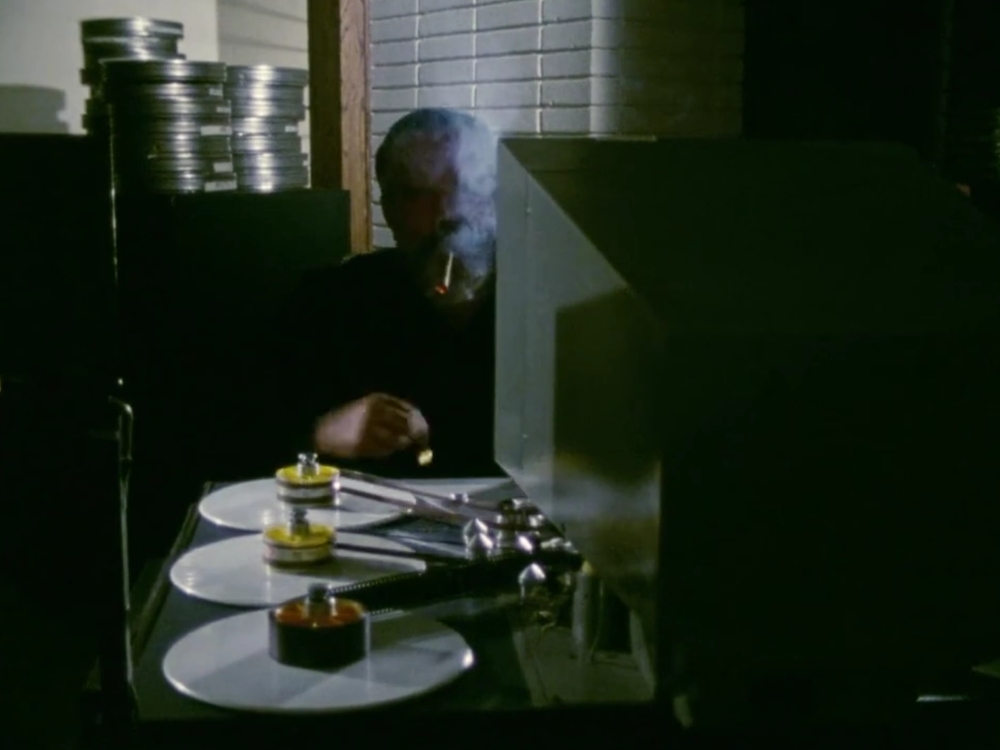
Welles’s death was a significant blow for Godard, who had long been in awe of the force of his visual imagination, versatility and formal inventiveness. The photographs of Welles in the final film are a nod to the project’s original conception. They are also, as Godard made clear in the synopsis, designed to remind us of Welles’s absence and our relative lack of passion compared to his. In addition, Welles’s Filming Othello (1978) had provided a pioneering model of what an essayistic audiovisual reflection on the filmmaking process might look like, paving the way for works by Godard such as Scénario du film Passion (‘Script of the film Passion’, 1982) and Histoire(s) du cinéma (1988–98).
As Godard’s Lear drifted, he considered numerous options for the lead role, including Clint Eastwood, Tony Curtis, Lee Marvin, Broderick Crawford, Rod Steiger and even Richard Nixon. Filming finally began in August 1986 with Norman Mailer and his daughter Kate in the roles of Lear and Cordelia, respectively. However, the Mailers abandoned the film after the first day of shooting. After a lengthy hiatus they were replaced by Burgess Meredith and Molly Ringwald, who were joined, among others, by Leos Carax, Julie Delpy, Woody Allen, Peter Sellars and Godard himself.
A near-final version of the film was shown at Cannes in 1987, Godard reportedly having been up for sixty-two hours working on the rough cut prior to the screening. Golan was incensed by what he deemed a meaningless mishmash of ‘bits of film assembled any old how’. The critical reception at Cannes was not much warmer. Over time, however, the film has come to be appreciated as a playful, personal and digressive, but nonetheless sincere and formally stunning, attempt to approach, enter and grapple with the world of Lear.
This screening will be introduced by Michael Witt.
Programme
Filming Othello, dir. Orson Welles, Germany 1978, 84 min
King Lear, dir. Jean-Luc Godard, USA 1987, 90 min
The final film retains traces of the various abandoned versions on whose ruins it is built. Godard’s initial idea was to film an interview with Orson Welles or Joseph Losey, who would play Lear as the owner of a Los Angeles parking lot or second-hand car garage. He also envisaged exploring how other filmmakers had approached Lear previously and contacted Losey, Welles, Laurence Olivier and Ingmar Bergman in the hopes of finding a guide to help him navigate what he termed the ‘foreign country’ of Shakespeare. Bergman and Welles accepted, but Welles sadly died shortly afterwards and Bergman ‘faded away’, as he put it.
Welles’s death was a significant blow for Godard, who had long been in awe of the force of his visual imagination, versatility and formal inventiveness. The photographs of Welles in the final film are a nod to the project’s original conception. They are also, as Godard made clear in the synopsis, designed to remind us of Welles’s absence and our relative lack of passion compared to his. In addition, Welles’s Filming Othello (1978) had provided a pioneering model of what an essayistic audiovisual reflection on the filmmaking process might look like, paving the way for works by Godard such as Scénario du film Passion (‘Script of the film Passion’, 1982) and Histoire(s) du cinéma (1988–98).
As Godard’s Lear drifted, he considered numerous options for the lead role, including Clint Eastwood, Tony Curtis, Lee Marvin, Broderick Crawford, Rod Steiger and even Richard Nixon. Filming finally began in August 1986 with Norman Mailer and his daughter Kate in the roles of Lear and Cordelia, respectively. However, the Mailers abandoned the film after the first day of shooting. After a lengthy hiatus they were replaced by Burgess Meredith and Molly Ringwald, who were joined, among others, by Leos Carax, Julie Delpy, Woody Allen, Peter Sellars and Godard himself.
A near-final version of the film was shown at Cannes in 1987, Godard reportedly having been up for sixty-two hours working on the rough cut prior to the screening. Golan was incensed by what he deemed a meaningless mishmash of ‘bits of film assembled any old how’. The critical reception at Cannes was not much warmer. Over time, however, the film has come to be appreciated as a playful, personal and digressive, but nonetheless sincere and formally stunning, attempt to approach, enter and grapple with the world of Lear.
This screening will be introduced by Michael Witt.
Programme
Filming Othello, dir. Orson Welles, Germany 1978, 84 min
King Lear, dir. Jean-Luc Godard, USA 1987, 90 min
02:00 pm
Sun, 07 Jun 2026
Cinema 1
Ticket information
- All tickets that do not require ID (full price, disabled, income support) can be printed at home or stored in email
- For aged-based concession tickets (under 25, student) please bring relevant ID to collect at the front desk before the event.
Access information
Cinema 1
- Both our Cinemas have step free access from The Mall and are accessible by ramp
- We have 1 wheelchair allocated space with a seat for a companion
- All seats are hard back, have a crushed velvet feel and they do not recline
- These are our seat size dimensions: W 42 x D 45 x H 52
- Arm rest either side of the seat dimensions: L 27 x W 7 x H 20
for the following requirements:
- We have unassigned seating. If you require a specific seat, please reserve this in advance
- Free for visitors where ticket prices are a barrier, please email
All films are ad-free and 18+ unless otherwise stated, and start with a 10 min. curated selection of trailers.
Members+ and all Patrons gain free entry to all cinema screenings, exhibitions, talks, and more.
Join today as a Member+ for £25/month.