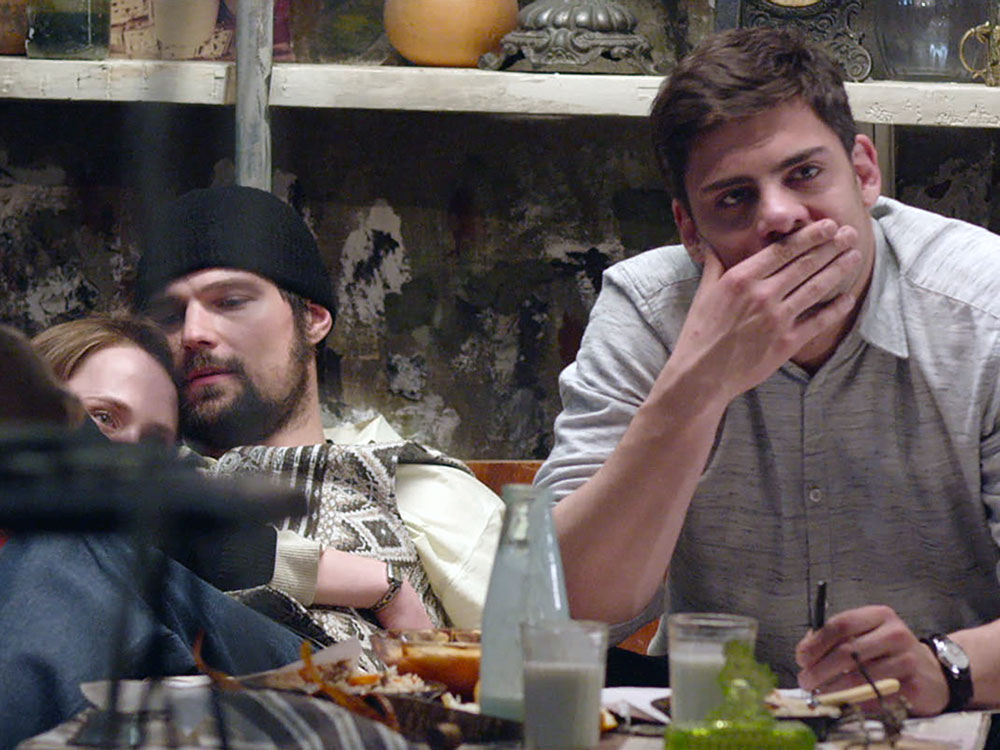
Outlaw-Matsu Returns Home, dir Shōhei Imamura, Japan 1973, Japanese with English subititles
Book tickets
“What’s your nationality?” Imamura asks a local in Pirates of Bubuan, to which he responds, puzzled: “Nationality?” This programme brings together three of Imamura’s mid-length television documentaries that turn distinctly toward the rural, the regional and the stateless: from the indigenous communities of the Sulu Archipelago, to Japanese soldiers who never returned home after the war, to a more light-hearted portrait of the hometown of Imamura’s mentor, Yūzō Kawashima, in the Shimokita Peninsula and its particular rituals of mourning.
Imamura’s frank, on-camera interviewing style is underwritten by his own forceful critiques of the nation-state and the mirage of its supposed unity. Across these films, he encounters people abandoned by the countries they once served, as well as rural communities poised on the edge of social change, where transformation is inseparable from a sense of impending loss.
Programme
My Shimokita (1972)
Part of the experimental TV travel show, “I Want to Go Far Away” (Tōku e Ikitai) which features rotating guest travelers – typically actors, musicians, or writers – as they explore various regions of Japan, Imamura’s episode features the director visiting the hometown of his mentor, Kawashima Yuzo, in the Shimokita region of Aomori Prefecture, in which he depicts the communities and their specific beliefs around life, death and reincarnation.
The Pirates of Bubuan (1972)
In Imamura’s ethnographic documentary, he visits the islands of the Sulu archipelago in southwest Philippines, drawn in by the rumour that pirates dominate the waters. Island hopping, the filmmaker focuses on the tensions between the dominant Muslim Tausug people who live on the larger, more economically prosperous islands against the indigenous fishing Badjao communities who are subject to discrimination.
Outlaw-Matsu Returns Home (1973)
A loose sequel to Imamura’s earlier documentary series "The Unreturned Soldiers", the film follows Fujita Matsukichi, a former superior private whom Imamura had interviewed in In Search of the Unreturned Soldiers in Thailand. Of the three men featured in that film, Fujita remains the most firmly attached to the righteousness of Japan’s Empire, with an almost anachronistic sense of patriotism. His return to Japan is marked by confusion and contradiction: between the radically different values of the pre- and postwar nation, and within his own fractured family. Outlaw-Matsu Returns Home excoriates the way Japan abandoned the individuals who had once served it, leaving them outside the social and political order of the new modernising nation.
Total runtime: 124 min.
Imamura’s frank, on-camera interviewing style is underwritten by his own forceful critiques of the nation-state and the mirage of its supposed unity. Across these films, he encounters people abandoned by the countries they once served, as well as rural communities poised on the edge of social change, where transformation is inseparable from a sense of impending loss.
Programme
My Shimokita (1972)
Part of the experimental TV travel show, “I Want to Go Far Away” (Tōku e Ikitai) which features rotating guest travelers – typically actors, musicians, or writers – as they explore various regions of Japan, Imamura’s episode features the director visiting the hometown of his mentor, Kawashima Yuzo, in the Shimokita region of Aomori Prefecture, in which he depicts the communities and their specific beliefs around life, death and reincarnation.
The Pirates of Bubuan (1972)
In Imamura’s ethnographic documentary, he visits the islands of the Sulu archipelago in southwest Philippines, drawn in by the rumour that pirates dominate the waters. Island hopping, the filmmaker focuses on the tensions between the dominant Muslim Tausug people who live on the larger, more economically prosperous islands against the indigenous fishing Badjao communities who are subject to discrimination.
Outlaw-Matsu Returns Home (1973)
A loose sequel to Imamura’s earlier documentary series "The Unreturned Soldiers", the film follows Fujita Matsukichi, a former superior private whom Imamura had interviewed in In Search of the Unreturned Soldiers in Thailand. Of the three men featured in that film, Fujita remains the most firmly attached to the righteousness of Japan’s Empire, with an almost anachronistic sense of patriotism. His return to Japan is marked by confusion and contradiction: between the radically different values of the pre- and postwar nation, and within his own fractured family. Outlaw-Matsu Returns Home excoriates the way Japan abandoned the individuals who had once served it, leaving them outside the social and political order of the new modernising nation.
Total runtime: 124 min.
Book tickets
Sun, 15 Nov 2026
Cinema 1
03:30 pm
Ticket information
- All tickets that do not require ID (full price, disabled, income support) can be printed at home or stored in email
- For aged-based concession tickets (under 25, student) please bring relevant ID to collect at the front desk before the event.
Access information
Cinema 1
- Both our Cinemas have step free access from The Mall and are accessible by ramp
- We have 1 wheelchair allocated space with a seat for a companion
- All seats are hard back, have a crushed velvet feel and they do not recline
- These are our seat size dimensions: W 42 x D 45 x H 52
- Arm rest either side of the seat dimensions: L 27 x W 7 x H 20
for the following requirements:
- We have unassigned seating. If you require a specific seat, please reserve this in advance
- Free for visitors where ticket prices are a barrier, please email
Members+ and all Patrons gain free entry to all cinema screenings, exhibitions, talks, and more.
Join today as a Member+ for £25/month.