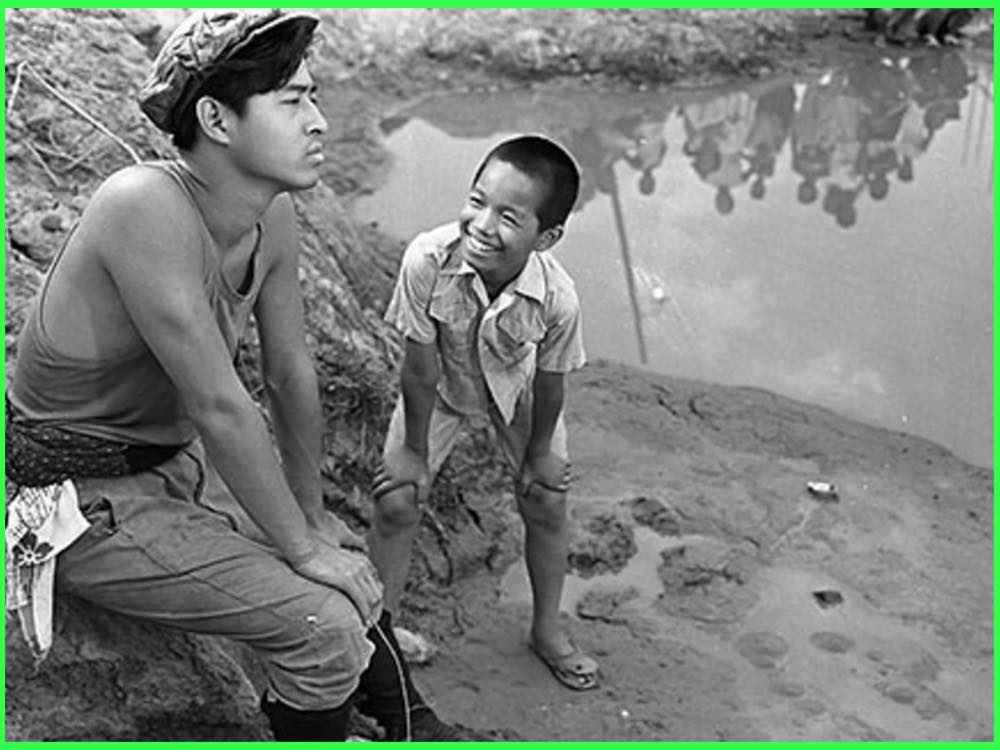
My Second Brother (にあんちゃん), dir. Shōhei Imamura, Japan 1959, Japanese with English subtitles, 101 min.
Book tickets
This double bill brings together two outliers from Imamura’s time as a director-for-hire for Nikkatsu, a minor comedy centred upon a henpecked husband's extra-marital affair and a profoundly tender exploration of the attempts of four orphaned children to make their way in the world, in the face of seemingly insurmountable odds.
Nishi-Ginza Station
An unconventional star vehicle for singer Frank Nagai, whose song opens the film and who serves as the film's occasionally omnipotent narrator, Nishi-Ginza Station is a rather crass comedy made between Imamura’s first two features that nonetheless retains Imamura’s eternal interest in humanity's most basic and inescapable desires.
The film centres upon the henpecked husband of a successful and strong-willed wife, who is convinced by a friend that his psychological issues would all be solved by simply engaging in an extra-marital affair, and what better time than now, while his wife is away. An ill-advised bender ensues but things become decidedly more complicated when the owner of the pen shop opposite shows an interest.
My Second Brother
Set in a beleaguered coal mining town, where unemployment is on the rise, Imamura’s final studio assignment centres upon four brothers and sisters, who following the death of their father find themselves orphaned and forced to confront the harsh realities of life as best they can.
An uncharacteristically tender film by Imamura’s standards, but one that in its preternatural attunement to the daily hardships of the working class, prefigures many of Imamura’s greatest works to come.
While the two films bear the marks of their enforced nature far more evidently than either Imamura’s debut or Endless Desire, in particular Nishi-Ginza Station, they also provide an intriguing glimpse of what’s to come. From the anthropological outlook and committed realism of My Second Brother to the bawdy humour and irrepressible female characters of Nishi-Ginza Station, much of what will define the remainder of Imamura’s body of work is already present in these early works, albeit in nascent form.
Nishi-Ginza Station
An unconventional star vehicle for singer Frank Nagai, whose song opens the film and who serves as the film's occasionally omnipotent narrator, Nishi-Ginza Station is a rather crass comedy made between Imamura’s first two features that nonetheless retains Imamura’s eternal interest in humanity's most basic and inescapable desires.
The film centres upon the henpecked husband of a successful and strong-willed wife, who is convinced by a friend that his psychological issues would all be solved by simply engaging in an extra-marital affair, and what better time than now, while his wife is away. An ill-advised bender ensues but things become decidedly more complicated when the owner of the pen shop opposite shows an interest.
My Second Brother
Set in a beleaguered coal mining town, where unemployment is on the rise, Imamura’s final studio assignment centres upon four brothers and sisters, who following the death of their father find themselves orphaned and forced to confront the harsh realities of life as best they can.
An uncharacteristically tender film by Imamura’s standards, but one that in its preternatural attunement to the daily hardships of the working class, prefigures many of Imamura’s greatest works to come.
While the two films bear the marks of their enforced nature far more evidently than either Imamura’s debut or Endless Desire, in particular Nishi-Ginza Station, they also provide an intriguing glimpse of what’s to come. From the anthropological outlook and committed realism of My Second Brother to the bawdy humour and irrepressible female characters of Nishi-Ginza Station, much of what will define the remainder of Imamura’s body of work is already present in these early works, albeit in nascent form.
Book tickets
Sun, 25 Oct 2026
Cinema 1
02:30 pm
Ticket information
- All tickets that do not require ID (full price, disabled, income support) can be printed at home or stored in email
- For aged-based concession tickets (under 25, student) please bring relevant ID to collect at the front desk before the event.
Access information
Cinema 1
- Both our Cinemas have step free access from The Mall and are accessible by ramp
- We have 1 wheelchair allocated space with a seat for a companion
- All seats are hard back, have a crushed velvet feel and they do not recline
- These are our seat size dimensions: W 42 x D 45 x H 52
- Arm rest either side of the seat dimensions: L 27 x W 7 x H 20
for the following requirements:
- We have unassigned seating. If you require a specific seat, please reserve this in advance
- Free for visitors where ticket prices are a barrier, please email
Members+ and all Patrons gain free entry to all cinema screenings, exhibitions, talks, and more.
Join today as a Member+ for £25/month.